The number and types of questions/elements you use on a survey will impact the length of time it takes a respondent to complete a survey and, of course, there can be a direct correlation between the length of time it takes to complete a survey and the completion rates for that survey.
Generally, shorter completion times result in higher completion rates.
To help you design a healthy survey, the estimated completion time is provided on the Health tab.
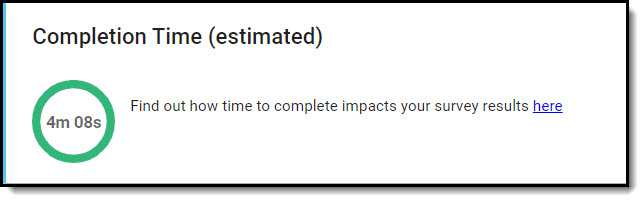
To calculate estimated completion times, we've assigned a point value to each of the different question types and elements that are available, and then we use the resulting point total to determine how the design of the survey will impact completion times.
If a question requires a complex or time consuming response (from the respondent's perspective), a higher point value is applied.
Here's a breakdown of the point values for the different question/element types:
|
1 Point
|
|
And for every two answer options (rounded up) on the following types:
And for each sub-section in a Matrix question |
|
2 Points |
|
| 3 Points for each of the following types: |
|
|
5 Points |
|
There are some best practices you can implement to optimize your survey and completion times, while still ensuring the data you collect is actionable and relevant.
Minimize the incidence of straight-lining behaviour
Straight lining occurs when respondents answer survey questions by clicking on the same response every time, without giving the required thought and attention to each question, and it can seriously compromise the integrity of the data that is collected.
This often happens when respondents don't accurately recall the details of their experience because too much time has passed, they become disinterested in the topic, or they find the survey too long or complicated.
To minimize straight-lining behaviour:
-
Limit the post-experience time-frame for responding to a survey invite.
-
Ideally respondents should complete a survey within 7 days post-experience.
-
A time frame of 2 weeks post-experience is acceptable.
-
-
Ask questions about salient events that people have a better chance of remembering.
-
Most people will not remember if the floors were clean, or if the cashier smiled at them, unless there was something odd or extraordinary about those aspects of their experience.
-
-
Do not make the questions mandatory.
-
People who do not know or do not remember details about those topics will give random answers.
-
-
Make the questions interesting and meaningful for the respondent.
-
The scope of a CSAT survey is to measure customer experience, and not necessarily location or employee performance. In other words, a business’s objective might differ from a customer's objective, even if both fall under the broad umbrella of customer satisfaction.
-
-
Avoid using the same types of questions throughout the survey
-
Respondents will sometimes click through and provide their answers to a series of questions in the same place or alternate answers in a predictable pattern. For example, on rating scales or matrix questions.
-
-
Avoid using too many questions that require complex input from the respondent.
-
Questions that require image, video or audio uploads are time consuming for the respondent and could deter them from completing the survey accurately, or at all.
- Text responses that require a lengthy response, or requiring the respondent to read a large amount of information or watch a video, can also impact completion times and rates.
-
Be sure to review our other articles about survey health for more recommendations & best practices!